
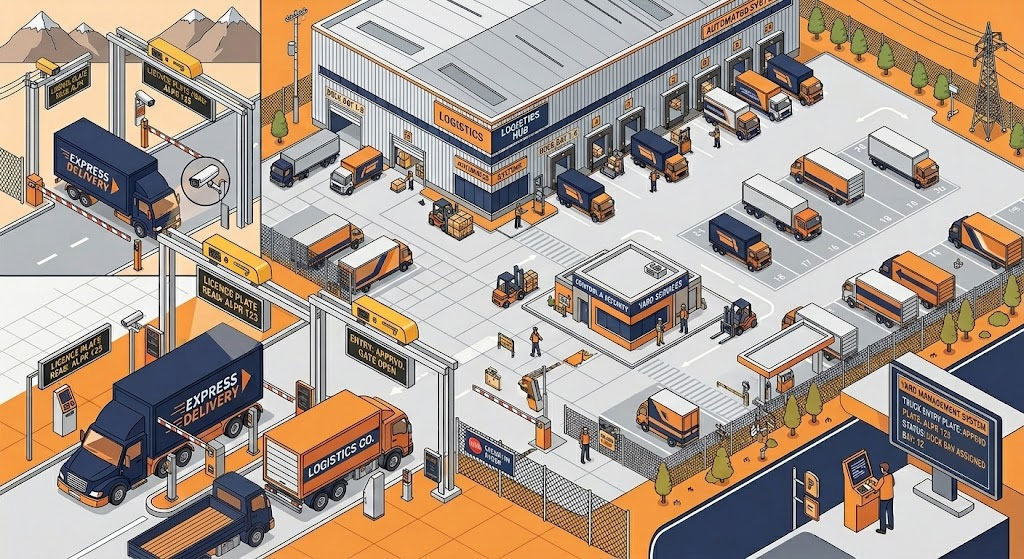
Today, logistics centers, warehouses, and distribution facilities handle a large number of vehicles entering and leaving their sites every day. In busy facilities, manually checking and recording truck information can take time and may cause congestion at entrance gates. Automatic License Plate Recognition (ALPR) technology can be used to identify vehicles more quickly and automate some of these entry and exit procedures.
ALPR systems mainly detect a license plate from an image captured by a camera and convert the characters on the plate into digital data. The recognized plate number can then be compared with vehicle information stored in a database. In a logistics facility, this can be particularly useful for controlling truck arrivals. For example, if the license plate of an expected truck has already been registered in the system, a camera can read the plate when the truck reaches the entrance and automatically check whether the vehicle is registered.
Automated Entry and Exit Control in Yard Management
One important application of license plate recognition in yard management is automated entry and exit control. When a vehicle enters the facility, its arrival time can be recorded together with its license plate number. When the same vehicle leaves, the plate can be read again and its departure time can also be recorded. In this way, the facility can maintain a digital record of the vehicles present in the yard.
Previous research has also examined the use of license plate recognition for monitoring vehicle entry and exit. In addition, management systems combining ALPR with technologies such as RFID and wireless sensor networks have been developed to enhance tracking accuracy and operational throughput.
Evaluating Yard Operations Through Operational Data
The information collected by these systems can be useful not only for vehicle identification but also for evaluating yard operations. For example, if the entry and exit times of a truck are known, the amount of time it spends inside the facility can be calculated.
If several trucks regularly experience long waiting times at certain entrance points, managers can use this information to identify possible delays in the operation. Therefore, ALPR can be considered not only as a security and identification technology but also as a source of useful data for yard management visual intelligence.
Technical Conditions and Environmental Considerations
However, several technical conditions should be considered for an ALPR system to work effectively in industrial environments:
- Image Quality: Resolution and clarity must be sufficient to process character details accurately.
- Lighting Conditions: Variability between daytime and nighttime lighting requires adaptive sensor adjustments.
- Camera Position: Positioning must accommodate vehicles approaching from different angles and speeds.
- Plate Obstructions: Dirty, damaged, or partially covered license plates can impact recognition performance.
In logistics yards, trucks may approach cameras from different angles and varying speeds. For this reason, appropriate camera placement and sufficient image quality are critical for reliable plate recognition.
Conclusion: Digitalizing Facilities for Better Movement Planning
In conclusion, integrating ALPR technology into logistics yard management can help companies monitor vehicle entry and exit more efficiently. Reducing manual plate recording, automatically identifying vehicles, and digitally storing arrival and departure times can make daily operations easier to manage.
Furthermore, combining this information with yard management systems can help identify waiting times and improve the planning of vehicle movements. For these reasons, ALPR can be considered a useful technology for the digitalization of logistics facilities and the overall improvement of yard operations.