
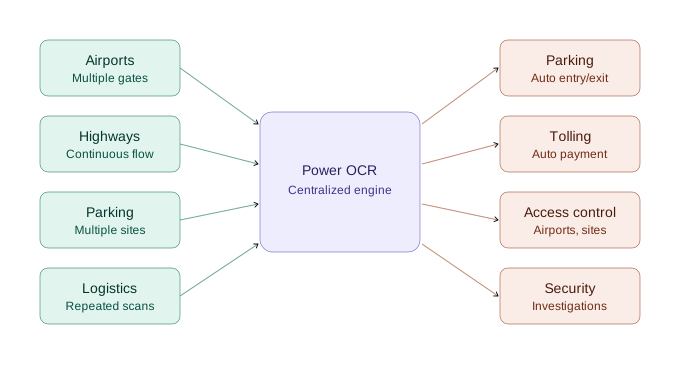
Choosing an ALPR system is about much more than simply asking, "Can it read the license plate?" Today, different cameras, Edge solutions, and ALPR software offer a wide range of options, and at first glance they all seem to promise the same thing: see the vehicle, read the plate, and send the result to the system. But in the real world, things are not that simple.
At an airport, hundreds of vehicles may pass through different security points at the same time. A highway network can generate millions of images throughout the day. At a logistics center, the same vehicle may be seen at different locations at different times. This is where choosing the right ALPR system really begins, because a powerful ALPR system should do more than simply read license plates.
It should centralize data, provide system-wide control, adapt quickly to change, optimize costs, and deliver high accuracy.
Power OCR's centralized ALPR architecture is positioned precisely at the intersection of these needs.
Data Centralization: Why Power OCR Brings the Entire Operation Together
A vehicle passes through the entrance of a facility. Hours later, the same vehicle appears at another point, then it is detected again at another location. Looking at each camera individually, these may appear to be three separate images — but a centralized ALPR system can turn those images into different pieces of the same story.
Power OCR's centralized architecture brings images and ALPR results from different locations together through a centralized intelligence layer, helping organizations manage vehicle activity from a much more complete perspective. This becomes especially important in large-scale operations: instead of data becoming isolated across individual cameras, it can be centrally managed, searched, and connected with operational systems. When an incident occurs, being able to find the relevant images and records within the system can completely change the speed of an investigation instead of spending hours searching through video footage.
Power OCR's strength is not simply seeing a license plate. It is turning visual data generated across different locations into one meaningful picture.
The cameras can be different. The locations can be different. The operations can be different. The intelligence can be centralized.
Privacy & Regulation: Power OCR Keeps Data Management Under Control
An ALPR system should not be evaluated only by what it sees, but also by how the data it captures is managed. A shopping center parking facility, an airport security area, and the entrance to a logistics facility may not have the same data management requirements — where data is stored, how it is processed, who can access it, and which systems it can be shared with may vary depending on the nature of the operation and the regulations that apply.
Power OCR's centralized approach provides an important layer of control here. Managing images and ALPR results within a centralized infrastructure can help organizations apply their own data policies and operational rules in a more controlled way. That is why centralized architecture is not simply a matter of performance for Power OCR.
It is about keeping data under control, managing it properly, and ensuring that it can be delivered to the right system in the right way when needed.
Because in modern ALPR, being powerful is not simply about generating data. It is about keeping control of that data.
Fast Adaptation: Power OCR Is Built for a World That Keeps Changing
A facility may control vehicle access only during certain hours today. Tomorrow, operating hours may change, a new access rule may be introduced, a new camera may be added, or an entrance may begin serving an entirely different operation. This is one of the biggest tests for real-world systems:
How quickly can the system adapt when change arrives?
Power OCR's centralized architecture provides a powerful advantage here. Because the system's core intelligence layer is centrally managed, many software changes, rule updates, and new integrations can be handled through the central infrastructure rather than requiring individual intervention at each camera location. This can make a significant operational difference, particularly in environments with hundreds of cameras: when a new entrance is added tomorrow, the entire architecture does not have to be rebuilt, and when a new location comes online, the existing centralized system can simply be expanded.
Power OCR is not designed simply to solve today's ALPR challenges. It is designed to provide an architecture ready for tomorrow's changes.
Cost Effectiveness: You Don't Need the Most Expensive Camera
There is a common mistake in ALPR investments: buying more expensive cameras in the hope of getting better results. But the ALPR performance story is not written by the price of the camera alone. What matters is image quality.
With Power OCR's centralized architecture, organizations can use high-quality, purpose-built cameras without requiring every camera to have its own high-cost AI processing infrastructure. The heavy visual analysis can instead be performed within the centralized Power OCR infrastructure, which can help organizations maintain greater control over hardware costs, particularly in projects involving large numbers of cameras.
So buying a more expensive camera is not always the smarter investment. High-quality imagery combined with powerful centralized ALPR intelligence can be a much more strategic combination. Power OCR focuses not on the price of the camera, but on maximizing the value of the images that camera produces.
High Accuracy: Centralized Computing Opens the Door to More Processing Power
A license plate is captured in the rain at night. The vehicle is moving, the viewing angle is not ideal, and other vehicles are visible in the background. This is where the real ALPR test begins: the system must perform not only under ideal conditions, but also within the complex visual environments of the real world.
This is where one of the key advantages of Power OCR's centralized architecture comes into focus. Processing power does not have to remain limited to the hardware available at the camera location — the centralized infrastructure can scale to leverage different high-performance computing resources, including CPU, GPU, or TPU. Unlike scenarios where an Edge approach may be constrained by the computing capacity available at each individual location, centralized infrastructure can provide access to significantly greater computing resources.
When large volumes of images arrive simultaneously, additional processing power can be brought into play, more sophisticated AI models can be deployed, and images can be analyzed more extensively — all under the control of a centralized ALPR architecture.
The camera captures the image. Power OCR's centralized infrastructure processes it. AI analyzes the license plate. The system delivers the result into the operational world.
ALPR is no longer simply a feature of the camera. It becomes a centralized, scalable visual intelligence infrastructure.
So, What Makes Power OCR Different?
The right ALPR system is not simply one that can read a license plate. It should centralize data and bring different locations together under a single intelligence layer. It should provide control over data and adapt quickly to change. It should maximize the value of high-quality imagery without depending on expensive camera investments, and when needed, it should be able to leverage powerful centralized computing resources such as CPU, GPU, or TPU to perform high-performance visual analysis.
This is exactly where Power OCR stands apart. Power OCR does more than read license plates — it brings cameras, images, data, AI, and operational systems together within a single centralized visual intelligence architecture.
Because in the ALPR world of tomorrow, the real question is no longer "Can the camera read the license plate?" The real question is:
"Can you scale this system across tomorrow's cities, companies, parking facilities, highways, and thousands of cameras?"
Power OCR's answer is clear:
One Centralized Intelligence. Many Cameras. One Powerful ALPR Infrastructure.