
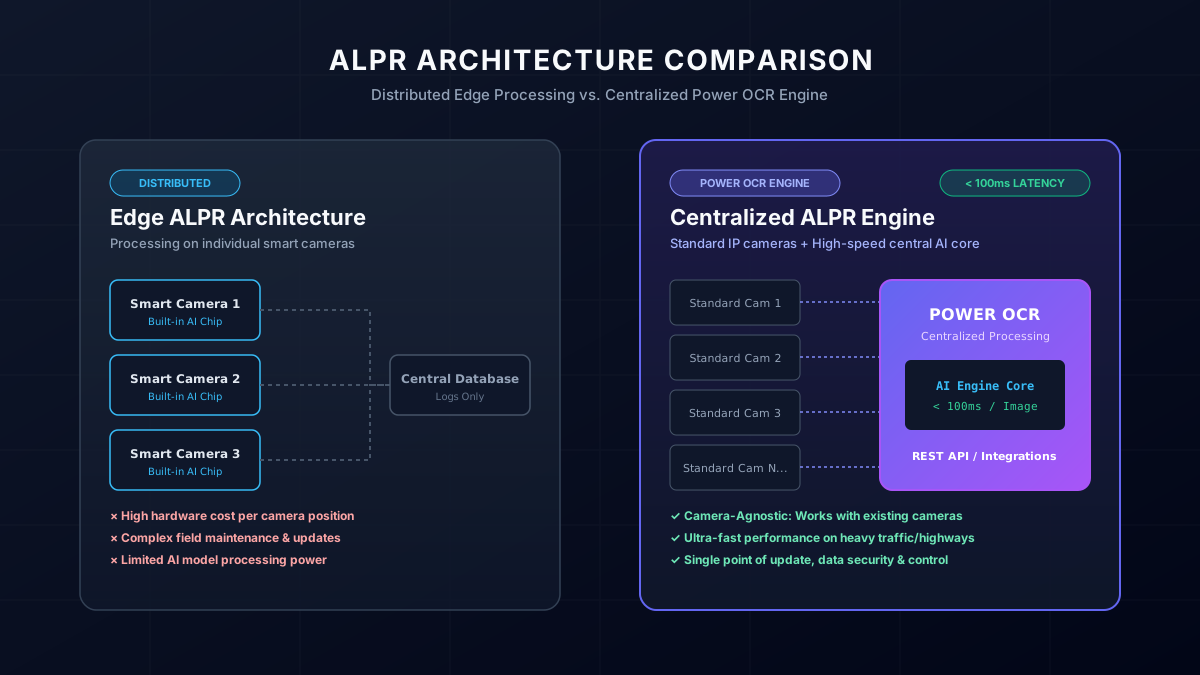
For years, the conversation around Automatic License Plate Recognition has focused on one deceptively simple question: where should the intelligence live? Should the image be processed right at the camera, as close to the vehicle as possible, or should the intelligence be centralized inside an organization's own infrastructure, where data, processing, security, and operational control can remain under one roof?
At first glance, Edge Computing appears to have the obvious advantage. The closer the processing happens to the camera, the less data needs to travel across the network — latency can be reduced, bandwidth requirements can be controlled, and decisions can potentially happen almost immediately at the point where the image is captured. But then reality enters the picture.
Modern ALPR environments are rarely made up of one camera watching one lane. They can involve hundreds or thousands of cameras, multiple parking facilities, highways, tolling points, airports, access-control systems, logistics centers, and even border crossings operating simultaneously. Suddenly, the question is no longer simply where the image should be processed — the real question becomes much more interesting.
How do you build an ALPR architecture that can handle massive visual workloads without sacrificing speed, accuracy, centralized control, or operational flexibility?
And this is where Power OCR enters the conversation. Because the future of ALPR may not belong exclusively to Edge Computing or traditional centralized On-Premises infrastructure — it may belong to the architecture that manages to take the strongest characteristics of centralized intelligence while eliminating the performance bottlenecks that have historically made large-scale centralized ALPR difficult.
The Edge Revolution Changed ALPR. But It Did Not End the Architecture Debate.
Edge Computing has transformed the way organizations think about visual intelligence. Instead of sending every image back to a central server, an Edge-based system can process information closer to the source — a camera or nearby device can detect a vehicle, identify a license plate, and potentially make an immediate decision without constantly depending on a remote processing environment.
For high-speed environments, this can be extremely attractive: a vehicle is moving, the camera captures it, the system needs to react, and every millisecond matters. This is one of the reasons Edge AI has become such an important concept across computer vision, intelligent transportation, security, and Smart City infrastructure.
But there is another side to the story. When intelligence is distributed across hundreds or thousands of locations, management can become significantly more complicated — hardware has to be deployed, devices have to be maintained, models may need to be updated, different sites can develop different configurations, and computing resources have to be provisioned across the network. As the number of cameras grows, the infrastructure grows with it, and the very characteristic that makes Edge powerful can also become one of its biggest operational challenges at scale.
The industry therefore faces a fascinating architectural dilemma: should intelligence live everywhere, or should it be centralized?
Why On-Premises Centralization Still Matters
There is a reason centralized On-Premises architecture continues to matter in enterprise and government environments. Organizations often want their data to remain inside infrastructure they control — they may already have sophisticated servers, databases, security policies, networking environments, access-control systems, and operational software in place, and they may not want every camera location to become its own miniature computing center.
Instead, they may want one centralized intelligence layer capable of serving multiple facilities, multiple camera systems, and multiple operational workflows. For organizations operating parking networks, highways, airports, logistics facilities, industrial campuses, government infrastructure, or border-control environments, centralized architecture can provide something that is difficult to replicate when intelligence is scattered across hundreds of individual Edge devices: centralized operational control.
The architecture becomes easier to govern. Data can remain within the organization's infrastructure, integrations can be managed centrally, software and AI models can be controlled from a central environment, and the organization can maintain a single operational brain across multiple locations. There is, however, one problem that has historically haunted centralized ALPR: performance.
The Centralized ALPR Problem: Too Much Vision, Too Little Time
Imagine hundreds — then thousands — of cameras continuously sending vehicle images into a centralized ALPR environment. Every image needs to be received, analyzed, processed, and converted into usable information. The challenge is not simply recognizing a license plate; the challenge is doing it repeatedly, reliably, and fast enough to keep up with the physical world.
A vehicle does not wait for the software. A highway does not pause because the server is busy. A parking gate does not stop operating because the recognition pipeline is processing another image. A tolling system cannot afford to turn every vehicle into a waiting transaction.
This is where centralized ALPR architectures have traditionally faced a difficult balancing act: more cameras mean more images, more images mean more computational demand, and more computational demand means more infrastructure. If the architecture cannot process that information quickly enough, the very centralized model that provides operational control can become a performance bottleneck. This is precisely the problem that makes the next generation of ALPR infrastructure so interesting, because the real breakthrough is not necessarily moving intelligence closer to the camera — it may be making centralized intelligence dramatically faster.
Power OCR Takes a Different Route
Power OCR approaches the problem from a different angle. Instead of accepting that centralized ALPR must inevitably become slower as the visual workload increases, the focus shifts toward high-performance GPU-accelerated processing. This is an important distinction — the objective is not simply to process an image, but to process an image fast enough that centralized intelligence can operate at the speed required by real-world transportation and mobility environments.
Power OCR's GPU-accelerated architecture is designed for high-density traffic flows and large-scale visual workloads, including highway surveillance scenarios. Its platform also supports deployment directly within an organization's own infrastructure, alongside cloud-based use, giving organizations flexibility over how and where their ALPR environment operates.
And according to the performance target provided for this Power OCR architecture, image processing can be completed in under 100 milliseconds. That number changes the conversation, because once centralized processing becomes fast enough, the traditional assumption that "centralized means slow" starts to lose its force. That is where Power OCR becomes much more than another ALPR product — it becomes an architectural proposition.
What If Centralized ALPR Could Move at the Speed of Edge?
This may be the most interesting question in the entire discussion. Edge Computing became attractive because it brought intelligence closer to the source. But what if centralized infrastructure could process visual information fast enough to deliver the responsiveness organizations expect from Edge environments while retaining the control and operational advantages of centralized architecture? That is the territory Power OCR is entering.
The difference is subtle, but strategically significant. Instead of asking organizations to place intelligence at every camera, Power OCR can allow the visual intelligence layer to remain centralized while using GPU acceleration to process incoming images at extremely high speed: the camera captures the image, the image reaches the ALPR infrastructure, the GPU-accelerated engine processes it, the plate is detected and recognized, the result is returned, and the operational system can act — all within a timeframe measured in milliseconds.
That creates a very different vision of what centralized ALPR can become.
The GPU Is Not Just About Speed. It Changes the Economics of Scale.
There is a tendency to talk about GPUs simply as "faster processors," but that explanation misses the bigger picture. In computer vision, large numbers of visual operations often need to be performed repeatedly across large volumes of images. GPU architectures are particularly well suited to highly parallel workloads, which is one reason they have become so important in modern AI inference.
For ALPR, this matters enormously. One vehicle image may be easy, but a highway filled with vehicles is something else entirely. One parking camera is manageable, but a nationwide parking network is a different engineering challenge. One tolling lane is one workload; hundreds of lanes operating simultaneously are another.
This is where GPU acceleration becomes strategically important. Power OCR is not simply trying to make one recognition request faster — the larger opportunity is to create an ALPR infrastructure capable of handling high-density visual workloads while keeping the intelligence centralized. That is a much more interesting proposition, because scalability is not just about adding more hardware; it is about increasing the amount of real-world activity a system can understand without forcing the architecture to become unnecessarily fragmented.
Under 100 Milliseconds Can Feel Very Different on a Highway
Imagine a vehicle traveling through a highway monitoring zone. The camera captures the vehicle, the system needs to recognize the plate, and the information needs to become useful before the vehicle has traveled another significant distance. This is where milliseconds stop being a technical statistic and start becoming an operational advantage.
Processing an image in under 100 milliseconds means the system is operating within a fraction of a second. For high-speed transportation environments, that responsiveness matters — for tolling, parking, access control, traffic intelligence, and high-density surveillance alike. When hundreds or thousands of vehicles are involved, the ability to process each image quickly becomes much more than a performance feature: it becomes part of the system's ability to keep up with reality.
The Real Advantage of On-Premises Appears When Speed Stops Being the Weakness
This is where the comparison between Edge and On-Premises becomes particularly interesting. Edge has a natural advantage when latency and local processing are the primary concerns. On-Premises has a natural advantage when centralized control, data governance, enterprise integration, and infrastructure ownership are critical. The problem has always been the performance gap — and Power OCR's GPU-accelerated architecture attacks that gap directly.
Instead of telling an organization that it must choose between centralized control and high-speed ALPR, the proposition becomes much more compelling:
Why not have both?
- Why should a large organization have to place an AI processing unit beside every camera simply to achieve fast recognition?
- Why should a city have to distribute its intelligence across hundreds of independent systems when it could operate a centralized visual intelligence layer?
- Why should an enterprise sacrifice centralized management simply because it needs millisecond-level responsiveness?
These are precisely the questions that make high-performance centralized ALPR such an interesting architectural direction.
One Brain. Many Cameras. One Intelligence Layer.
There is another major advantage to centralized architecture that becomes increasingly important as deployments grow: consistency. When intelligence is distributed across many Edge devices, each device becomes part of the operational architecture — hardware, software, models, updates, configurations, and monitoring all have to be managed across the network.
A centralized ALPR platform creates a different operational model. The intelligence can live in one controlled environment; cameras become visual sensors, and the centralized ALPR infrastructure becomes the intelligence layer. The organization can connect multiple camera sources into the same recognition environment, which is particularly powerful for multi-site operations — a parking operator managing multiple facilities, a transportation authority operating hundreds of lanes, a logistics company with multiple warehouses, an airport with different access zones, or a government organization operating infrastructure across an entire region.
In each case, the organization does not necessarily need hundreds of independent ALPR brains — it may need one powerful brain capable of understanding images coming from many locations. That is the promise behind centralized visual intelligence, and this is where Power OCR's architecture becomes particularly compelling.
Camera-Agnostic ALPR Changes the Conversation Again
There is another strategic dimension that makes centralized ALPR especially interesting: the camera does not necessarily have to be the intelligence, it can simply be the sensor. Power OCR's platform is positioned to receive images through existing camera infrastructure and process them centrally, rather than forcing organizations to replace their entire camera ecosystem with specialized ALPR cameras. The company's published architecture describes standard IP cameras functioning as image sensors, with the image sent to an ALPR API for detection, OCR, rule processing, decisions, and integrations.
That changes the economics of deployment. Organizations already have cameras, networks, and infrastructure, and they may not want to replace all of it. Instead of turning every camera into an AI computer, the intelligence can be centralized — meaning the organization can potentially scale recognition without multiplying specialized AI hardware at every physical location.
The camera sees. Power OCR understands. That is a very different architecture from the traditional assumption that the camera itself must become intelligent.
Edge vs. On-Premises Is No Longer a Simple Winner-Takes-All Battle
The industry has spent years framing Edge and centralized architectures as competing philosophies, but the future may be more nuanced. Edge remains extremely powerful in scenarios where immediate local decisions, disconnected operation, or ultra-low network dependency are essential. Centralized On-Premises remains extremely attractive when organizations need control, security, integration, centralized management, and data governance.
The real breakthrough comes when centralized infrastructure becomes fast enough to remove one of its biggest historical disadvantages — that is exactly where GPU-accelerated ALPR becomes important. Power OCR is effectively challenging an old assumption:
Centralized does not have to mean slow.
And if that assumption can be broken at scale, the architecture conversation changes completely.
Power OCR Is Not Just Reading Plates. It Is Building an ALPR Engine for the Real World.
Real-world license plates are not laboratory objects. They are dirty, partially obscured, and appear at different angles. They move through changing lighting conditions, can be blurred, can appear against complicated backgrounds, and can be captured from different distances — and sometimes multiple vehicles appear in the same image.
Power OCR's published ALPR capabilities specifically address difficult visual conditions including low light, motion blur, partially obscured or dirty plates, complex backgrounds, angled plates, and multi-line plates. That matters because the real ALPR market is not about recognizing the perfect license plate — it is about recognizing the plate that appears at 2:17 in the morning, in bad weather, under poor lighting, at an angle, while the vehicle is moving.
That is where technology proves itself, and that is where high-speed processing and recognition accuracy have to coexist. Speed without accuracy is useless; accuracy without speed is operationally limiting. The real engineering challenge is achieving both.
From Parking to Highways, the Architecture Can Scale With the Mission
Once centralized GPU-accelerated ALPR becomes the intelligence layer, the number of possible applications expands dramatically:
- Parking operators can use it to automate vehicle entry and exit.
- Transportation authorities can use it for high-volume traffic monitoring.
- Tolling operators can use it to identify vehicles and automate transaction workflows.
- Airports can use it for access control.
- Logistics companies can use it to track vehicle movement across facilities.
- Industrial organizations can use it to manage controlled access.
- Government institutions can deploy it across large surveillance environments.
- Border infrastructure can use it as part of a broader vehicle identification and modernization strategy.
The technology remains fundamentally the same; what changes is the operational environment. That is one of the strongest characteristics of an API-driven ALPR platform — the intelligence does not have to be rebuilt for every industry, since the same recognition engine can become part of different operational workflows.
This Is Where ALPR Becomes Infrastructure
There is a major difference between selling an ALPR feature and building ALPR infrastructure. A feature answers a specific problem; infrastructure becomes part of the system that solves many problems. Power OCR is moving toward the second category.
Its ALPR capabilities can operate through REST APIs, allowing organizations to send images into the recognition engine and receive structured recognition results that can then be integrated into their own software environments. That means Power OCR does not have to replace the parking management system, the tolling platform, or the access-control software — it can become the intelligence layer underneath them.
This is a powerful position, because once an ALPR engine becomes infrastructure, its value is no longer limited to the screen where the recognition result appears. It becomes part of the organization's operational nervous system.
The Future May Not Be Edge or On-Premises. It May Be High-Performance Centralized Intelligence.
This is where the entire debate comes full circle. Edge Computing showed the world that AI does not always need to live in the cloud. Centralized On-Premises architecture showed enterprises that intelligence can remain under their own control. Now high-performance GPU-accelerated ALPR is opening another possibility: what if centralized intelligence could be fast enough to support real-time environments without forcing organizations to distribute the entire AI stack to the edge?
What if hundreds of cameras could feed a centralized ALPR engine? What if thousands of images could be processed rapidly, while the organization keeps its data and intelligence inside its own infrastructure? What if the same platform could connect to parking, tolling, security, fleet management, access control, and Smart City systems?
That is no longer simply a question about where ALPR should run — it is a question about what ALPR infrastructure should become. And this is precisely where Power OCR has an opportunity to stand apart.
Power OCR Is Turning Centralized ALPR Into a Performance Story
The most interesting thing about Power OCR is not that it chose On-Premises. It is that it is challenging the assumption that On-Premises ALPR has to compromise on speed. By combining centralized architecture with GPU-accelerated processing and image processing targeted at under 100 milliseconds, Power OCR is positioning centralized ALPR as a serious option for environments where speed and scale are non-negotiable.
That is a much bigger story than simply saying "we have an ALPR engine." It is a story about architecture, performance, scalability, and control — and ultimately, it is a story about how cities, enterprises, transportation authorities, and government institutions can build visual intelligence without giving up ownership of the infrastructure that runs it.
The Next ALPR Race Will Not Be About Who Can Read a Plate
License plate recognition is entering a new phase. The technology has already learned how to detect plates; now the industry is competing over something much bigger:
- Who can process more images?
- Who can respond faster?
- Who can maintain accuracy under real-world conditions?
- Who can scale across hundreds or thousands of cameras?
- Who can integrate with existing enterprise systems?
- Who can give organizations centralized control without sacrificing real-time performance?
- Who can transform ALPR from a camera feature into an intelligence infrastructure?
That is the real race, and Power OCR is stepping directly into it. The camera may be sitting at the edge, the data may be coming from a highway, and the vehicle may be moving at full speed. The parking facility may be processing thousands of entries, the tolling network may be handling continuous traffic, and the border crossing may be operating around the clock. But behind all of those environments, there can be one centralized intelligence layer capable of turning visual information into decisions at remarkable speed.
That is the vision. Not simply faster ALPR. Not simply centralized ALPR. Not simply GPU-powered ALPR.
A new generation of high-performance visual intelligence infrastructure built for the physical world.
And that is why the Edge vs. On-Premises debate may ultimately have the wrong question. The future may not belong to the architecture that processes data closest to the camera, nor will it necessarily belong to the architecture that keeps everything in one central server. The future may belong to the architecture that gives organizations the best balance of speed, accuracy, control, scalability, and intelligence.
With GPU-accelerated processing, sub-100-millisecond image processing, centralized deployment, API-driven integration, and an ALPR engine designed for real-world visual conditions, Power OCR is making a compelling argument for exactly that future. Because the next generation of ALPR will not simply be about recognizing what a camera sees.
It will be about understanding the world at the speed at which it moves.
And that is where Power OCR wants to be.