
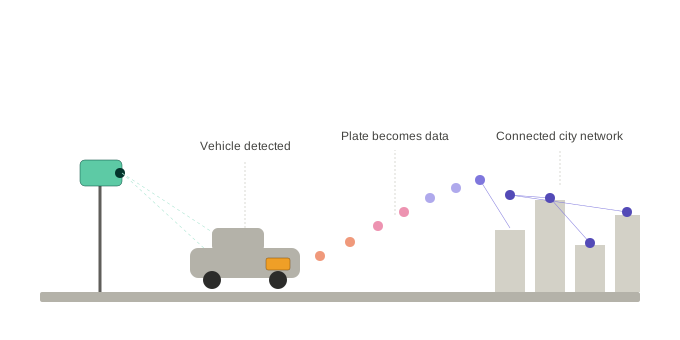
Picture a city. A vast, living organism where millions of people live, thousands of vehicles move every second, parking lots fill and empty, cars flow along highways, and hundreds of vehicles pass through border crossings. Everything is constantly in motion, and in the middle of it all there is something cities are quietly watching: vehicles.
A car passes in front of a camera. The driver may not even notice it. A few seconds later, the vehicle continues on its way, but those few seconds are no longer just an image. Artificial intelligence detects the vehicle captured by the camera, recognizes its license plate, interprets the image, and transforms that moment into digital data — where the vehicle passed, when it passed, which system it passed through, and, when necessary, what should happen next. All of these questions can now be answered without human intervention.
This is where ALPR, or Automatic License Plate Recognition, enters the picture. But describing the story of ALPR simply as "artificial intelligence reads a license plate" would dramatically underestimate the much larger transformation unfolding before us, because the real issue is no longer just recognizing the letters and numbers on a plate — it is making the physical world in motion digitally understandable. And this is where the much bigger story begins.
Cameras Are No Longer Just Watching. They Are Beginning to Understand Cities.
For years, the job of cameras was relatively simple: record what happened and allow someone to review it when necessary. If an incident occurred in a parking facility, the footage could be reviewed; vehicle activity on a highway could be examined; after a security event, hours of footage could be searched manually. The camera could see, but it did not actually understand what it was seeing — the image was there, but the meaning came from the human mind. Today, that equation is changing.
AI-powered ALPR systems can detect vehicles captured by cameras, identify license plates, and transform those images into structured digital data. More importantly, that data can communicate with other software systems — a vehicle captured by a camera can now trigger a parking transaction within seconds, create a tolling record, or send information to another operational system. At this point, the camera is no longer simply a security device: it is becoming one of the city's eyes, and ALPR becomes the technology that understands what those eyes are seeing.
The scale of this transformation becomes clear when we consider the size of modern cities — millions of vehicles, thousands of cameras, and an enormous stream of visual data flowing continuously throughout the day. It is simply impossible for humans to manually analyze all of it. This is where artificial intelligence enters the picture, transforming images from something merely recorded into information that can actually be understood. That is why, in the cities of the future, the real value may not lie in the camera itself, but in what can be created from what the camera sees.
Why Could a License Plate Become One of the Most Valuable Data Points of the Future?
At first glance, a license plate looks like an ordinary object — a few letters, a few numbers, and a small plate attached to a vehicle. But in the digital world, a license plate can become an extremely powerful data point capable of digitally identifying a physical vehicle.
When a vehicle passes in front of a camera, an ALPR system is not simply reading the plate — it can turn that image into an event. The time of passage can be recorded, the location can be associated with it, and if the vehicle has entered a parking facility, a parking transaction can be initiated. If it is traveling through a toll road, a tolling record can be created; if it is crossing a border, the information can be shared with the relevant systems. In other words, the story does not actually begin when the license plate is read — it begins after the license plate has been read. And that is where the real opportunity for technology companies begins to emerge.
Because being able to accurately read a license plate is important, but it is not enough on its own. The data that has been captured needs to have a real-world purpose: it needs to connect to something, and it needs to trigger an action. This is where the defining competition in the future of ALPR is likely to take place — not simply in recognition accuracy, but in how that data can connect to other systems and what real-world operations it can activate.
Smart Parking: The Invisible Revolution Transforming Parking Facilities
When you enter a parking facility today, you may actually be stepping into the middle of a quiet technology revolution. Traditional parking was highly mechanical — you took a ticket, the barrier opened, you drove inside, searched for your ticket when leaving, made a payment, and the barrier opened again. Today, that same experience is becoming increasingly invisible.
A vehicle approaches the entrance, a camera sees it, and the ALPR system recognizes the license plate. The system identifies the vehicle and records its entry time; when the vehicle reaches the exit, it is recognized again, the parking duration is calculated, and with the right infrastructure in place, the payment process can be handled automatically. From the driver's perspective, all of this may feel like nothing more than a few seconds of added convenience. From the parking operator's perspective, however, something much bigger is happening: the parking facility is becoming a digital infrastructure that generates its own data.
When does demand peak? How long do vehicles typically stay? Which areas are reaching capacity, which spaces are used most frequently, and which vehicles return most often? During which time periods could pricing or capacity be optimized? When properly analyzed, ALPR-generated data can transform a parking facility from a simple place where vehicles are stored into an intelligent system capable of understanding its own behavior, optimizing its operations, and becoming part of the broader movement of a city.
That is where the real meaning of Smart Parking begins. It is not simply about opening a barrier automatically — it is about the parking facility beginning to understand itself.
Could AI Replace the Toll Booths of the Future?
The transformation taking place on highways is just as compelling. For decades, toll roads were associated with booths, barriers, and waiting vehicles, but the goal of modern transportation infrastructure is increasingly different: vehicles should be able to keep moving, tolls should be detected automatically, and payments should be handled through a digital process that is as invisible as possible. ALPR can play a critical role here.
A vehicle passes in front of a camera, its license plate is detected, and the time of passage and relevant information are captured. The system communicates with the appropriate tolling infrastructure, and the transaction can be completed with as little intervention from the driver as possible. This transformation does more than improve the user experience — it can also influence traffic flow, with less stopping, less waiting, and a smoother transportation experience.
But once again, the bigger story is data. Every passage creates another data point, and when millions of passages come together, they create a vast pool of information that can help cities and transportation operators understand traffic behavior in far greater detail. That is why AI-powered ALPR can become more than a license plate recognition technology in future tolling infrastructure — it can become one of the digital eyes of the transportation system itself.
A New Era Is Emerging at the Border
One of the most strategic applications of ALPR may be border crossings, because these are not simply places where vehicles move from one point to another — they are highly complex infrastructures where security, speed, data verification, and operational coordination must all be managed simultaneously.
A vehicle approaches a border crossing, the system sees it, and the license plate is recognized. The time of passage is recorded, and information can be exchanged with the necessary systems. When ALPR works alongside document analysis, security infrastructure, and centralized data systems, what emerges is no longer simply a license plate recognition system, but a much more comprehensive digital passage architecture. This is where the concept of Border Modernization becomes important.
The border crossing of the future does not necessarily have to be a place with more personnel or simply more cameras — it can evolve into an infrastructure that is more intelligent, more connected, and capable of processing data in real time. Vehicle imagery, license plate information, time, location, document data, security systems, and API connections can all come together within the same ecosystem, transforming a border crossing into something resembling a digital organism — and ALPR can become one of the nervous systems of that organism.
When Visual AI Enters the Picture, the Story Gets Much Bigger
ALPR is a powerful technology, but its real potential becomes even more compelling when it is viewed as part of Visual AI. Because cameras do not see only license plates — they see vehicles, traffic, different types of vehicles, parking spaces, road conditions, environmental variables, camera angles, and changing visual conditions.
That means the visual intelligence systems of the future will not stop at answering the question "What is this license plate?" — they will increasingly seek to understand the entire scene within a broader context. This is where ALPR becomes an important component of Visual AI, and it is precisely where the strategic opportunity for Power OCR becomes particularly interesting. The goal is not simply to extract information from a camera; it is to understand the image, transform it into structured data, move that data across different systems, and, when necessary, enable it to trigger an operation in the real world.
The camera sees, AI understands, data is created, systems communicate, and a decision becomes an action in the physical world.
That is the story of the visual infrastructure of the future.
The Real Battle Is Not About Cameras. It Is About the World Cameras Can See.
In the years ahead, we are almost certain to see more cameras across our cities, but the real competition will not be about the number of cameras. A city generating millions of hours of footage means very little by itself — if that footage is simply stored, the city has done little more than create an enormous digital archive. The real value emerges when the footage can be understood.
When a vehicle appears, the system needs to recognize that it is a vehicle, identify its license plate, record the passage, and make that data available to another system. That is why the most valuable technology in future cities may not be the camera itself — it may be the artificial intelligence that understands what the camera sees. And this is precisely where ALPR takes on such a critical role, because it is one of the most tangible technologies connecting vehicle movement in the physical world with data in the digital world.
API Infrastructure: The Gateway That Opens Visual Intelligence to the World
Even an exceptionally powerful ALPR system can use only a fraction of its potential if it remains a closed box. Modern cities are not built around a single software system — they run on:
- Parking systems
- Tolling platforms
- Fleet management systems
- Municipal software
- Security infrastructure
- Enterprise platforms
- Border control systems
All of these systems need to be able to communicate with one another, and that is where API Infrastructure enters the picture. If a company can add AI-powered license plate recognition capabilities to its existing software without having to build its own ALPR infrastructure from scratch, the technology can scale much faster. That makes the ALPR API approach much more than a technical detail — it is, in fact, a commercial infrastructure layer that allows visual intelligence to spread across industries.
This layer is critically important to Power OCR's long-term vision. The objective is not simply to create software that works on its own, but to build a visual intelligence layer capable of operating across different camera systems, parking platforms, municipal infrastructures, transportation systems, and enterprise solutions — a model that could become one of the most important strategic factors distinguishing Power OCR from a traditional software product.
Power OCR's Real Story Is Not OCR
And perhaps this is the most interesting part of the story. When someone hears the name Power OCR for the first time, it is natural to associate the company with OCR technology, but the company's long-term story goes far beyond Optical Character Recognition — the real story is much bigger.
The physical world is constantly generating images. Cameras capture those images, artificial intelligence can interpret them, ALPR can bring vehicles and license plates into the digital world, Visual AI can reveal the broader meaning contained within an image, and API Infrastructure can then carry that intelligence into other systems. Seen from this perspective, Power OCR's future position extends far beyond that of an OCR engine — the real opportunity is to build scalable infrastructure that transforms visual data from the physical world into machine-readable digital intelligence:
- ALPR is one of the strongest entry points into that architecture.
- Visual AI expands the intelligence layer.
- API Infrastructure carries that intelligence across different systems.
- Smart Parking creates direct commercial value.
- Tolling brings the technology into transportation infrastructure.
- Border Modernization opens the door to high-value public infrastructure.
For that reason, evaluating Power OCR's future simply by looking at the word "OCR" would mean missing one of the most important chapters of the story.
In the Cities of the Future, Digital Trails May Matter as Much as the Vehicles Themselves
A vehicle moving through a city is constantly creating physical events — it enters a district, passes through a parking facility, travels along a highway, approaches a border crossing, and reaches another destination. Today, these may appear to be separate and unrelated events; tomorrow, they could become pieces of the same digital story.
ALPR captures those movements, Visual AI interprets the images, APIs move the data across different systems, and artificial intelligence analyzes that data. Together, all of these technologies can help cities make faster and more informed decisions, and this is where the real transformation of the Smart City concept begins. A smart city is not simply a city with more sensors — it is a city capable of understanding the data it generates and turning that data into real-world outcomes.
The Future the Cameras Are Already Seeing
Perhaps a few years from now, we will look at scenes that seem completely ordinary today through very different eyes. A car will enter a parking facility; the driver will do nothing. The camera will see the vehicle, ALPR will recognize the license plate, and the system will digitally match the vehicle as the parking transaction begins. As the vehicle leaves, the system will recognize it again, the fee will be calculated, the barrier will open, and the entire process will happen within seconds. The same technology will perform another role on a highway, another role at a border crossing, another role within a city's Smart City infrastructure, and another within a fleet management system — yet beneath all of these different scenarios will be the same fundamental idea.
The camera will no longer simply see. It will understand what it sees.
And that is exactly what makes the future of ALPR so important, because the issue is no longer simply whether a license plate can be read — it is whether the physical world in motion can be understood in real time. When that transformation takes place, ALPR will no longer be merely a security technology, a parking solution, or a tolling component; it will become an important part of the digital infrastructure of cities.
The Big Opportunity Ahead for Power OCR
The opportunity ahead for Power OCR lies precisely within this transformation — not becoming a camera company, not simply becoming a license plate recognition software company, and not merely becoming an API provider. The real opportunity is to become part of a scalable visual intelligence infrastructure that can serve multiple industries by:
- Understanding vehicles through ALPR
- Interpreting visual environments through Visual AI
- Moving that intelligence across different systems through API Infrastructure
- Touching the everyday operations of cities through Smart Parking
- Entering transportation infrastructure through Tolling
- Contributing to the future of border crossings through Border Modernization
All of these capabilities can ultimately come together under a single technology vision. Because the world's cities will generate more images, more vehicles will move, more cameras will operate, and more data will be created — but the future will not be determined by the amount of visual data produced.
It will be determined by how quickly and intelligently that visual data can be transformed into meaningful information.
Perhaps one of the most important technologies of the future is hiding precisely here. A camera will quietly operate somewhere in a city; a vehicle will pass in front of it, and no one will think twice about it. But within seconds, artificial intelligence will read that image, understand it, transform it into digital data, and, when necessary, trigger other systems to take action. While people continue with their lives, the city itself will begin to understand what is happening around it — and that is when we will realize that ALPR is not simply reading license plates.
ALPR is becoming one of the most powerful tools for translating the physical world into a digital language. That is where Power OCR's greatest opportunity lies, because the technology race of the future will not be built solely around creating better cameras.
The real competition of the future will be about who can understand the world seen by those cameras better than anyone else. And the winners of that race will not simply be companies selling software — they will be the companies building the infrastructure that becomes part of the digital nervous system of tomorrow's cities.