
Parking is no longer simply a place where vehicles are left. It is rapidly transforming into a digital operating center where thousands of vehicles enter, exit, spend time, and generate actionable data as they move through the city.
In the past, parking investment was strictly defined by physical infrastructure: barriers, ticket machines, payment terminals, and standalone cameras. Today, forward-thinking investors are asking a fundamentally different question: How intelligent can a parking facility become, and how can we build a robust technology infrastructure without continuously buying more expensive hardware? This is exactly where Power OCR's centralized ALPR approach comes into play.
The Parking Lot Is Becoming a Technology Platform
When a vehicle enters a modern parking facility, it is no longer just a passive physical object. A camera captures its image, the ALPR system recognizes the license plate, and the exact entry timestamp is recorded. As the vehicle moves through the facility and exits, it is detected once more—automatically calculating duration and triggering the payment workflow within seconds.
Power OCR operates as the high-performance intelligence layer behind the cameras. By centralizing recognition processing, a physical parking location evolves into a real-time data platform that optimizes traffic flow and operational efficiency.
Why Parking Investors Should Look Beyond the Camera
The total technology cost of a parking investment extends far beyond the price tag of individual cameras. Computing power, servers, Edge processors, control units, software integrations, and ongoing maintenance all contribute significantly to long-term operational expenditures.
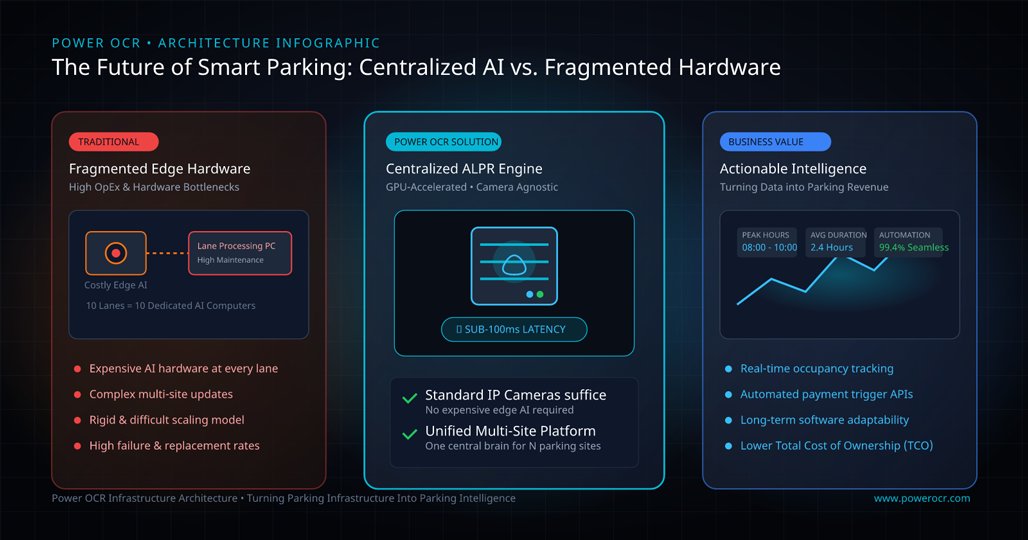
Traditional deployment models demand buying heavy hardware for every single lane. Power OCR challenges this norm: Does every camera really need its own expensive AI computer?
The Core Philosophy: Spend on raw image quality at the edge, but centralize the processing intelligence within the Power OCR infrastructure.
With this architecture, cameras function purely as high-quality visual sensors. Images are streamed directly to Power OCR's central engine, where AI handles detection and OCR, returning real-time data to the parking management platform. This removes the necessity for high-cost AI processing units at every physical entrance and exit.
Centralized ALPR Alters the Economics of Scale
An investor operating a single parking site today may manage ten or more facilities across different cities tomorrow. Centralized architecture proves its true financial value as operational scope expands.
- Unified System Management: Instead of configuring fragmented edge units at every property, Power OCR manages feeds across multiple sites in one centralized environment.
- Seamless Expansion: New cameras, lanes, and entire facilities can be onboarded into the existing system with minimal integration friction.
- Future-Proofing Infrastructure: When payment gateways, subscription rules, or mobile apps change, updates occur centrally without requiring hardware retrofits at each location.
Smart Parking Is About More Than Opening the Gate
A vehicle passing a barrier is merely the starting event; the true strategic value lies in the data generated behind it. Through clear analytics and system integrations, Power OCR empowers operators to track peak operational hours, high-density traffic zones, average stay durations, and demand fluctuations.
Ultimately, the competitive advantage in tomorrow's parking industry will not rely on simply accommodating more vehicles, but on building a smarter, highly scalable, and cost-efficient technology ecosystem. Power OCR turns physical parking infrastructure into actionable parking intelligence.